

Information for candidates and students with disabilities
Information for candidates with disabilities
Challenges* that students enrolled in the Veterinary Medicine program may encounter during classes conducted in the following formats:
| lectures and seminars | laboratory classes | clinical classes | field-based classes | professional internship |
Hearing impairment |
| × difficulties in direct communication with the course instructor, potentially hindering the achievement of learning outcomes | × difficulties perceiving and interpreting certain animal signals, particularly auditory cues; × difficulties in verbal communication (e.g., conducting an interview with a patient’s owner); × may prevent or significantly impair the performance of medical examinations (e.g., auscultation of animals);
| × difficulties perceiving and interpreting certain animal signals, particularly auditory cues; × difficulties in verbal communication (e.g., conducting an interview with a patient’s owner); × may prevent or significantly impair the performance of medical examinations (e.g., auscultation of animals);
| × difficulties perceiving and interpreting certain animal signals, particularly auditory cues; × difficulties in verbal communication (e.g., conducting an interview with a patient’s owner); × may prevent or significantly impair the performance of medical examinations (e.g., auscultation of animals);
|
Speech impairment | × may lead to problems with delivering presentations at seminars; × may prevent answering questions asked by the course instructor or fellow students; | × difficulties in direct communication with the course instructor, potentially hindering the achievement of learning outcomes; × may prevent answering questions asked by the course instructor or fellow students; | × difficulties in direct communication with the course instructor, potentially hindering the achievement of learning outcomes; × difficulties in verbal communication with the course instructor or the patient’s owner (including e.g., conducting an interview, informing about test results, diagnosis, treatment, recommendations); | × difficulties in direct communication with the course instructor, potentially hindering the achievement of learning outcomes; × difficulties in verbal communication with the course instructor or the patient’s owner (including e.g., conducting an interview, informing about test results, diagnosis, treatment, recommendations); | × difficulties in direct communication with the course instructor, potentially hindering the achievement of learning outcomes; × difficulties in verbal communication with the course instructor or the patient’s owner (including e.g., conducting an interview, informing about test results, diagnosis, treatment, recommendations); |
Visual impairment |
| × impairments in color discrimination, visual–motor coordination, and shape recognition; × difficulties in reading measurement results, interpreting microscopic and macroscopic images, and performing laboratory work; | × impairments in color discrimination, visual–motor coordination, and shape recognition; × difficulties in reading measurement results, interpretation of microscopic and macroscopic images, diagnostic difficulties, problems reading non-verbal signals of animals, hindered or delayed reaction to animal behavior, problems performing clinical examinations and identifying pathological changes (e.g., on the skin); | × impairments in color discrimination, visual–motor coordination; × difficulties in reading measurement results, interpretation of microscopic and macroscopic images, diagnostic difficulties, problems reading non-verbal signals of animals, hindered or delayed reaction to animal behavior, problems performing clinical examinations and identifying pathological changes (e.g., on the skin); | × impairments in color discrimination, visual–motor coordination; × difficulties in reading measurement results, interpretation of microscopic and macroscopic images, diagnostic difficulties, problems reading non-verbal signals of animals, hindered or delayed reaction to animal behavior, problems performing clinical examinations and identifying pathological changes (e.g., on the skin); |
Other types of disabilities |
| × serious limitations are disorders of the sense of smell, touch, and balance; × proper upper limb function and dexterity of the hands and fingers are necessary; × studies are possible for individuals with minor lower limb dysfunction that does not preclude standing and walking; | × serious limitations are disorders of the sense of smell, touch, and balance; × a serious limitation may be hypersensitivity to light and sounds when working with animals; × proper upper limb function and dexterity of the hands and fingers are necessary × studies are possible for individuals with minor lower limb dysfunction that does not preclude standing and walking | × serious limitations are disorders of the sense of smell, touch, and balance; × a serious limitation may be hypersensitivity to light and sounds when working with animals; × proper upper limb function and dexterity of the hands and fingers are necessary; × studies are possible for individuals with minor lower limb dysfunction that does not preclude standing and walking | × serious limitations are disorders of the sense of smell, touch, and balance; × a serious limitation may be hypersensitivity to light and sounds when working with animals; × proper upper limb function and dexterity of the hands and fingers are necessary; × studies are possible for individuals with minor lower limb dysfunction that does not preclude standing and walking |
*/ The scale of possible challenges depends on the degree of the student’s disability and the advancement of their rehabilitation.
Note: A veterinarian should have a genuine interest in animals and demonstrate an appropriate approach toward both animal owners and veterinary patients. The veterinary profession requires the ability to think quickly and logically, fine motor skills, perceptiveness, rapid response and decision-making abilities, composure, and the capacity to work under time pressure and criticism (which may at times be non-constructive). It also requires psychological resilience, emotional stability, and physical endurance. A veterinarian should possess imagination and the ability to divide attention, as well as demonstrate courage, responsibility, and sound judgment. Well-developed interpersonal and communication skills are essential, as veterinary practice is largely based on ongoing contact and cooperation with animal owners in a variety of settings. Significant limitations may arise from difficulties in social communication or emotional instability. In laboratory and clinical classes, group work is mandatory, as is collaboration with animal owners.
During the Veterinary Medicine program, students may be exposed to strong and unpleasant odors, bright lighting, noise, and work in challenging weather conditions. In laboratories, offices, and seminars, devices that generate various information and background sounds may be present. Studying is often accompanied by stress related to time-pressured learning, resulting from a high number of assessments within a short period and strict grading criteria.
Any questions should be directed to:
Dr. Kaja Urbańska, Coordinator for Students with Disabilities, tel.: 22 59 36 219; e-mail: kaja_urbanska@sggw.edu.pl.
Dr. hab. Joanna Pławińska-Czarnak, Coordinator for Students with ASD, tel.: 22 59 36 076; e-mail: koordynator_asd@sggw.edu.pl.
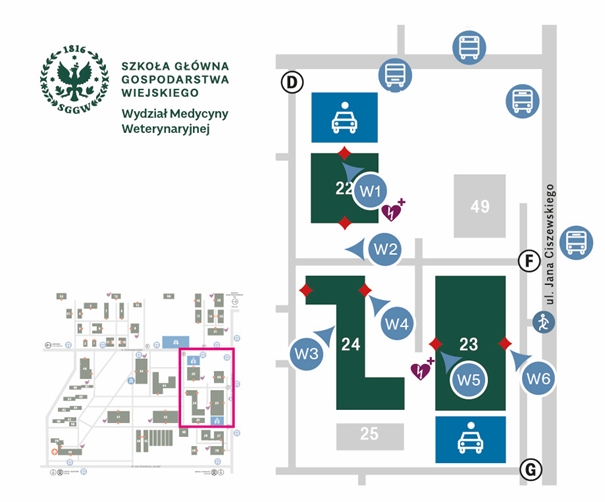
Architectural Accessibility
Building No. 24, Faculty of Veterinary Medicine 159 Nowoursynowska Street 02-776 Warsaw, Poland
Access to the building includes a ramp for persons with disabilities.
- Sidewalks around the buildings are even, with local curb cutouts facilitating movement for wheelchair users.
- Entrance doors (W3 and W4 – wheelchair ramp access) to the building are not adapted for persons with disabilities (manually operated).
- One parking space is designated for persons with disabilities.
- From the parking area, access to the building is possible from two sides, both with lowered curb thresholds, as well as via one ramp from the side of Building No. 23 (W4).
- Inside the building, on the ground floor, there is a porter’s desk / monitoring station, where a person can be found who will provide information and additional assistance.
- At Entrance W3, on both the left and right sides, there are lockers for students.
- Lecture halls are equipped with induction loops.
- It is possible to use the following equipment: a wheelchair, crutches, and a four-wheeled walker.
- A toilet for persons with disabilities is located on the ground floor.
- Wide corridors, with no bottlenecks or thresholds in the building.
- An elevator for persons with disabilities is located directly opposite Entrance W3.
- Entry with an assistance dog or guide dog is permitted. The following are required: a certificate for the assistance dog and a vaccination certificate.
Building No. 22 – Small Animal Clinic Faculty of Veterinary Medicine 159C Nowoursynowska Street 02-776 Warsaw, Poland
- Parking (from the W2 side): one parking space designated for persons with disabilities. It is necessary to bring a parking permit and place it behind the windshield.
- From the parking area, access to the building (from the W2 side) is possible from two directions, with a lowered curb threshold and two ramps.
- Access routes to the building include a total of four ramps for persons with disabilities (two at Entrance W1 and two at Entrance W2).
- Entrance doors are not adapted for persons with disabilities (manually opened, with a vestibule). One entrance is equipped with automatically opening doors operated by a photocell, which are currently out of use (W1).
- Wide corridors, with no narrowings or thresholds in the building.
- There is no reception desk. At Entrance W2, there is an unattended cloakroom and backpack lockers located in the corridor on the left-hand side. On the basement level, there is monitoring, where a person providing information and additional assistance can be found.
- Two passenger elevators adapted for persons with disabilities (W1 and W2).
- The lecture hall is equipped with an induction loop.
- The following equipment is available in the building: a wheelchair, crutches, and a four-wheeled walker.
- On each of the three floors (to the right of the elevator), there is a toilet for persons with disabilities.
- Entry with an assistance dog or guide dog is permitted. Required documents include a certificate for the assistance dog and proof of vaccination.
Building No. 23 Faculty of Veterinary Medicine Faculty of Animal Breeding, Bioengineering and Animal Protection Analytical Center 8 Ciszewskiego Street 02-786 Warsaw, Poland
- Two parking spaces for persons with disabilities are located on the right side of the parking lot, and one parking space is located from the swimming pool side.
- From the parking area, access to the building is possible from two entrances: W6 – Main entrance from Ciszewskiego Street, and W5 – on the opposite side of the building, facing Building No. 24, both with a lowered curb threshold.
- Two ramps are available from Ciszewskiego Street (W6).
- Entrance doors near the elevators are adapted for persons with disabilities (automatically opening and easy to operate).
- Staircases have properly marked step edges. Sidewalks are even and do not have locally lowered curbs.
- Wide corridors, with no narrowings or thresholds in the building.
- Two passenger elevators adapted for persons with disabilities (W5 and W6).
- Lecture halls are equipped with induction loops.
- The following equipment is available in the building: a wheelchair, crutches, and a four-wheeled walker.
- There is no reception desk in the building. At the basement level entrances, there are unattended cloakrooms on both sides of the building (W5 and W6). On the basement level, there is monitoring, where a person able to provide information and additional assistance can be found.
- On each floor, there is a toilet for persons with disabilities, located to the right of the elevator.
- Entry with an assistance dog or guide dog is permitted. Required documents include a certificate for the assistance dog and proof of vaccination.
Coordinator for Students with Disabilities:
Dr. Kaja Urbańska
Phone: +48 22 59 36 219
E-mail: kaja_urbanska@sggw.edu.pl
Coordinator for Students with ASD:
Dr. hab. Joanna Pławińska–Czarnak
Phone: +48 22 59 36 076
E-mail: koordynator_asd@sggw.edu.pl